
From High Costs to Predictable, Qualified Leads
A construction company approached us, struggling with inconsistent lead flow and rising acquisition costs. Their campaigns lacked precision, resulting in wasted spend and low-quality inquiries. In just 90 days, we restructured their paid media strategy, delivering 90–120 qualified leads, reducing cost per lead, and significantly improving return on ad spend.
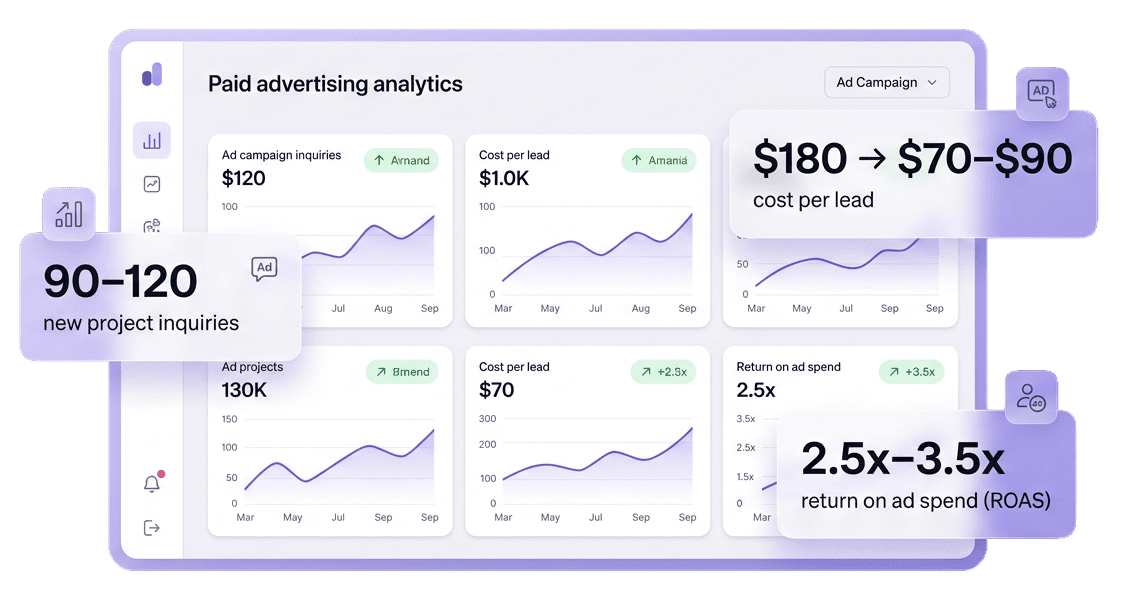
qualified leads in 90 days
cost per lead
return on ad spend
The Opportunity
Before working together, the company relied on broad targeting and inconsistent campaign structures. While they were investing in paid ads, results were unpredictable and often inefficient.
With strong demand in their market, the opportunity was clear: refine targeting, improve lead quality, and turn ad spend into a consistent and scalable growth channel.
The goal
Create a predictable lead-generation system that delivers high-quality leads while reducing costs and maximizing ROI.

The Challenge
Despite running active campaigns, several key issues, such as high cost per lead, inconsistent results, and broad targeting that attracted low-quality inquiries, constrained performance. In addition, a lack of alignment between ads, landing pages, and user intent, combined with inefficient budget allocation across platforms, led to wasted spend and missed opportunities to convert high-intent prospects in a highly competitive market.
TURNING STRATEGY INTO MEASURABLE GROWTH
Not all leads are equal, and more volume doesn’t always mean better results. We approached the project with a focus on intent, qualification, and efficiency. Instead of simply increasing traffic, we built a system designed to attract the right audience at the right moment.
We restructured campaigns across Google and Meta to align targeting, messaging, and user journey, ensuring every click had a higher probability of converting.
Because behind every lead is a real project, and being visible at the right moment drives real growth.

We didn’t approach this as a lead volume problem; we approached it as an alignment gap between intent, targeting, and conversion.
What We Did
We approached this differently from the start. Rather than focusing on volume alone, we rebuilt the paid media strategy around precision, intent, and performance.
Campaigns were restructured by service type, location, and intent level to reach higher-value prospects, while audience targeting was refined through custom audiences, lookalikes, and intent-based signals to improve lead quality.
At the same time, we developed clear, conversion-focused messaging aligned with customer needs and decision stages and optimized landing pages to reduce friction and increase lead capture. Budget was then strategically reallocated toward top-performing campaigns, ensuring every dollar worked harder.
The result was not just more leads, but stronger alignment between audience intent and the brand’s offering, turning paid media into a consistent source of qualified opportunities.
The Impact
In just three months, the new strategy delivered significant improvements across key performance metrics, generating between 90 and 120 qualified leads while reducing cost per lead by over 50%, from $180 to as low as $70-$90. At the same time, return on ad spend increased to between 2.5x and 3.5x, turning paid media into a far more efficient and scalable channel.
By aligning targeting, creative, and the user journey with real buyer intent, the company didn’t just generate more leads; it built a more predictable system for attracting high-quality opportunities ready to convert.